
SEO Forecasting: How to Predict Your Traffic in an AI Era
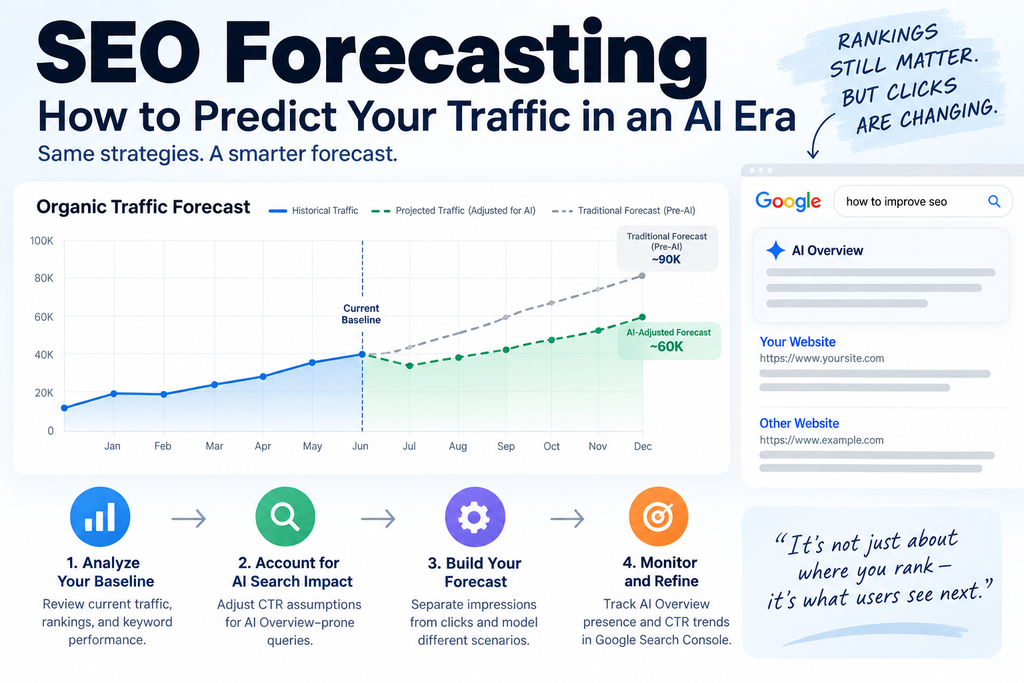
SEO forecasting has become more challenging in the age of AI search. If you’ve built an SEO traffic forecasting model any time in the last couple of years, you’ve probably watched it miss. Not because your keyword research was wrong or your ranking predictions were off — but because ranking well no longer guarantees a click the way it used to.
AI Overviews, ChatGPT, and other AI-powered search experiences have changed what happens after someone searches. People can often get an answer without ever visiting a website. That shift doesn’t mean forecasting is broken. It means the assumptions behind traditional forecasting models need to change.
For SEO teams, agencies, and businesses, the goal is no longer simply to predict how many keywords will reach the top 10. A useful forecast needs to estimate what those rankings are actually worth in terms of impressions, clicks, and organic traffic.
Here’s how to build a more realistic SEO forecast for the search landscape you have today.
Start With Your Current SEO Baseline
Every credible SEO forecasting process starts with the same thing: understanding what is already happening before predicting what’s next.
Start by reviewing your current organic traffic, impressions, clicks, average positions, and keyword performance. Look at which pages generate the most traffic and which keywords are responsible for those visits.
Your baseline should answer a few important questions:
- How much organic traffic are you receiving today?
- Which pages generate the majority of organic clicks?
- Which keywords are already ranking on page one?
- Which keywords are close to breaking into the top positions?
- What is your current organic CTR?
- Which topics have grown or declined over the past several months?
- How much of your traffic comes from informational versus transactional searches?
Historical data gives your forecast a starting point. Without it, you are essentially guessing.
It is also important to separate branded and non-branded traffic. Branded searches can behave very differently from non-branded searches, particularly when estimating the potential impact of AI search features.
A strong baseline gives you something to measure against when you revisit the forecast later.
Table of Contents
Why AI Search Throws Off Traditional Forecasts
Traditional SEO forecasting models often rely on a simple assumption: if a page reaches a particular ranking position, it will receive a predictable percentage of available clicks.
For example, a model might estimate traffic using search volume multiplied by an expected CTR for a ranking position. The calculation can look straightforward:
Estimated Traffic = Search Volume × Expected CTR
The problem is that search results pages are becoming more complicated.
AI Overviews, featured snippets, knowledge panels, local results, shopping results, videos, and other SERP features can all compete for attention before a traditional organic listing receives a click.
AI-powered search adds another layer to the problem. A user may search for a question, read an AI-generated answer, and never visit any of the websites that contributed information to that answer.
This is particularly relevant for informational queries such as:
- “What is SEO?”
- “How does keyword research work?”
- “How do I improve website traffic?”
- “Why is my website not ranking?”
- “What is technical SEO?”
These searches have traditionally been important sources of top-of-funnel organic traffic.
That doesn’t mean informational content has become useless. It means the relationship between ranking and traffic is becoming less predictable.
A modern SEO forecasting model therefore needs to account for the difference between visibility and visits.
Rankings Do Not Automatically Equal Traffic
One of the most important concepts in modern SEO forecasting is separating visibility from traffic.
A keyword can generate impressions without generating many clicks. A page can rank well while receiving fewer visitors than historical CTR benchmarks would suggest.
Consider a simplified example.
Imagine a keyword receives 10,000 searches per month. Your forecast assumes that reaching position three will produce a 10% CTR.
That produces an estimate of:
10,000 × 10% = 1,000 clicks
But if AI-generated search features and other SERP elements reduce the effective CTR to 6%, the same ranking would produce:
10,000 × 6% = 600 clicks
The ranking prediction was correct.
The traffic prediction was wrong.
That distinction is critical when presenting forecasts to clients, managers, or stakeholders.
A forecast should therefore avoid saying:
“We will rank in position three, so we will receive 1,000 visits.”
Instead, it should say:
“If we reach position three, we estimate approximately 600–1,000 monthly clicks depending on the SERP and CTR behavior.”
That range is more useful because it acknowledges uncertainty.
A Practical Framework for SEO Forecasting Today
The solution isn’t to abandon forecasting. Instead, update the model so it reflects how search works today.
1. Separate Impressions From Expected Clicks
Start by forecasting visibility separately from traffic.
Your model can estimate:
Projected Impressions → Expected CTR → Projected Clicks
This makes it easier to identify where an assumption is responsible for a change in the forecast.
For example, if projected impressions increase but projected clicks remain flat, the model may be assuming that CTR will decline.
That is much more informative than simply changing the final traffic number.
2. Build CTR Assumptions by Query Type
Avoid using one CTR curve for every keyword.
Informational, commercial, transactional, branded, and navigational searches can behave differently.
Create separate assumptions for different keyword groups.
For example:
| Keyword Type | Search Behavior | Forecasting Approach |
|---|---|---|
| Informational | Often answer-oriented | Consider a stronger CTR adjustment |
| Comparison | Research-focused | Monitor SERP features closely |
| Commercial | Product/service research | Use historical CTR where available |
| Transactional | High purchase intent | Validate against actual site data |
| Branded | Strong navigational intent | Use your own historical performance |
These categories should not be treated as fixed rules. Your own Search Console data should eventually replace generic benchmarks wherever enough historical data is available.
3. Identify AI Overview–Prone Keywords
Not every keyword has the same exposure to AI search features.
Create a list of your target keywords and monitor whether AI Overviews or other AI-generated search experiences appear for them.
You can categorize keywords as:
- No AI feature observed
- Occasionally triggered
- Frequently triggered
- Consistently triggered
Then use these categories when calculating expected CTR.
This makes your SEO forecasting model more responsive to actual search behavior instead of relying entirely on historical position-based CTR.
4. Monitor Organic CTR Trends
Google Search Console is particularly useful here.
Look at impressions, clicks, CTR, and average position together.
One important pattern to watch is:
Stable rankings + increasing impressions + declining CTR
If rankings remain relatively stable while CTR falls, something may have changed in the search results.
AI features may be one factor, but they are not the only possible explanation. Changes in competitors, SERP features, search intent, titles, snippets, and seasonality can also affect CTR.
The important point is to investigate the change rather than assuming that ranking stability means traffic stability.
5. Create Multiple Forecast Scenarios
A single traffic forecast can create false precision.
Instead, build at least three scenarios:
Conservative scenario: Lower ranking gains and lower CTR.
Expected scenario: Reasonable ranking improvements and current CTR assumptions.
Upside scenario: Strong ranking improvements and favorable CTR behavior.
For example:
| Scenario | Ranking Growth | CTR Assumption | Monthly Traffic |
|---|---|---|---|
| Conservative | Moderate | Lower | 35,000 |
| Expected | Strong | Moderate | 50,000 |
| Upside | Strong | Higher | 65,000 |
The exact numbers should come from your own data rather than generic benchmarks.
This approach makes your forecast easier to communicate because stakeholders can see how different assumptions affect the outcome.
How to Calculate an SEO Traffic Forecast
A simple model can start with keyword-level calculations.
Suppose a keyword has:
- Monthly search volume: 20,000
- Expected ranking: Position 4
- Estimated CTR: 5%
The basic forecast would be:
20,000 × 5% = 1,000 expected clicks
Now assume the query frequently displays AI-generated search features and you adjust the expected CTR to 3%.
The revised calculation becomes:
20,000 × 3% = 600 expected clicks
That is a 40% difference in projected traffic without changing the ranking assumption.
For a large keyword set, you can calculate this for every keyword and then aggregate the results.
A simplified model might look like:
Forecast Traffic = Σ(Search Volume × Expected CTR × Ranking Probability)
The ranking probability factor can be useful because SEO outcomes are rarely guaranteed.
For example, if your model estimates a 70% probability of reaching a particular ranking, you can incorporate that uncertainty into the forecast rather than assuming the ranking will definitely happen.
More advanced models can also include seasonality, historical growth rates, conversion rates, branded versus non-branded traffic, and changes in search demand.
Informational vs. Transactional Keywords: A Quick Comparison
AI search does not affect every keyword equally, so keyword intent should be part of your forecasting process.
| Keyword Type | Potential AI Search Impact | Forecasting Adjustment |
|---|---|---|
| Informational (“how to,” “what is”) | Often higher | Consider a lower CTR assumption |
| Comparison (“best,” “vs”) | Variable | Monitor SERP changes and CTR |
| Commercial (“SEO tools,” “CRM software”) | Variable | Use historical CTR where possible |
| Transactional (“buy,” “pricing”) | Query-dependent | Validate against actual conversion data |
| Branded | Often different from generic queries | Use first-party historical data |
The goal isn’t to assume that one category always performs better than another.
The goal is to understand search intent and use that information to make your forecast more realistic.
A Real Example: “How To” Keywords in Practice
Consider a website targeting a collection of “how to” keywords.
The initial forecast is built using historical search volume and a position-based CTR model. The SEO team expects several pages to reach the top three positions over the next six months.
Based on the old model, the traffic projection looks strong.
However, after monitoring the search results, the team discovers that many of those queries regularly display AI-generated answers and other SERP features.
The ranking opportunity hasn’t necessarily disappeared. The pages can still rank well.
But the expected click opportunity has changed.
Instead of forecasting traffic purely from ranking position, the team reduces the CTR assumptions for affected keywords and produces a new forecast.
This produces a more realistic picture.
The lesson is simple: the value of a ranking depends on what happens around that ranking.
A position-three ranking on one SERP may generate very different traffic from a position-three ranking on another SERP.
Don’t Ignore Search Demand and Seasonality
Another common forecasting mistake is assuming that search volume stays constant throughout the year.
Many industries have significant seasonal patterns.
For example:
- Travel searches may increase during holiday planning periods.
- Ecommerce searches can rise around major shopping events.
- Tax-related searches can be highly seasonal.
- Education searches can follow academic calendars.
- B2B searches may fluctuate around business cycles.
If your forecast uses a single monthly search-volume number for the entire year, it may produce misleading results.
Historical Search Console and keyword data can help identify these patterns.
When possible, compare the same months across previous years rather than simply applying a fixed growth rate.
The Biggest SEO Forecasting Mistake to Avoid
If you take one thing from this article, it should be this:
Don’t assume ranking equals traffic.
A ranking is an opportunity to receive visibility. Traffic is the result of what users do after seeing that visibility.
Your forecast should therefore account for:
- Search demand
- Ranking probability
- SERP features
- Expected CTR
- AI Overview exposure
- Seasonality
- Branded versus non-branded searches
- Historical website performance
- Search intent
- Conversion value
The more of these variables you can support with first-party data, the more useful your forecast becomes.
You also shouldn’t present a forecast as a guarantee.
SEO forecasting is inherently uncertain because rankings, search demand, competitors, algorithms, and user behavior can all change.
A forecast is a planning model, not a promise.
How Often Should You Update Your SEO Forecast?
A forecast should evolve as new data becomes available.
For a rapidly changing SEO environment, review your assumptions at least quarterly.
However, monthly monitoring can be useful for important websites or competitive industries.
During each review, compare:
Forecast vs. Actual
Look at:
- Actual organic clicks
- Actual impressions
- Average position
- Actual CTR
- Keyword ranking changes
- New or lost keywords
- SERP feature changes
- AI Overview presence
- Seasonal changes
Then identify which assumptions were wrong.
For example, perhaps rankings grew exactly as expected but CTR was lower than forecast. That tells you the next model should adjust its CTR assumptions.
This feedback loop is one of the most valuable parts of SEO forecasting.
SEO Forecasting Tools and Data Sources
You don’t need an extremely complicated system to create a useful forecast.
Some of the most valuable data can come from tools you already use.
Google Search Console
Search Console provides first-party information about impressions, clicks, CTR, and average position.
This makes it one of the most important sources for understanding how your existing organic visibility translates into traffic.
Google Analytics
Analytics can help connect organic traffic with engagement, conversions, revenue, and other business outcomes.
Traffic alone doesn’t tell you whether SEO is producing business value.
Keyword Research Platforms
Keyword research tools can provide estimates of search volume, keyword difficulty, rankings, and competitive information.
Use these estimates as inputs rather than treating them as exact measurements.
Your Own Historical Data
Your website’s historical performance is often more valuable than a generic industry CTR benchmark.
If a group of keywords has consistently produced a certain CTR at particular ranking positions, that evidence should influence your assumptions.
From Traffic Forecasting to Business Forecasting
The ultimate purpose of SEO forecasting isn’t simply to predict sessions.
Businesses usually care about what those sessions produce.
You can extend your model from:
Rankings → Impressions → Clicks → Sessions
to:
Rankings → Impressions → Clicks → Sessions → Conversions → Revenue
For example, if your forecast estimates 10,000 additional organic visits and your historical conversion rate is 2%, the model could estimate approximately 200 additional conversions.
If the average value per conversion is known, you can estimate the potential business value.
This makes SEO forecasting much more useful for budgeting and strategic planning.
It also changes the conversation with stakeholders.
Instead of saying:
“We expect 20 new top-three rankings.”
You can say:
“Our model estimates that the projected ranking improvements could generate approximately X additional organic visits and Y additional conversions under the expected scenario.”
The second statement connects SEO activity to business outcomes.
Build Forecasts That Can Be Challenged
A good forecast should not be a black box.
Document the assumptions behind it.
For every major projection, record:
- Current traffic baseline
- Target keywords
- Search volume source
- Expected ranking
- Ranking probability
- CTR assumption
- AI search adjustment
- Seasonal adjustment
- Conversion rate
- Revenue assumption
This allows someone else to understand how the forecast was produced.
It also makes future updates easier.
When actual performance differs from the forecast, you can identify which assumption caused the difference instead of simply declaring the forecast inaccurate.
FAQs
Does AI Overview presence mean a keyword isn’t worth targeting?
No. AI Overview presence means the potential traffic value of the keyword should be evaluated carefully.
A keyword can still provide visibility, brand exposure, authority, and potential citations even when some users do not click through to a website.
The right decision depends on the keyword’s intent, business value, competition, conversion potential, and actual SERP behavior.
How often should I re-check which keywords trigger AI Overviews?
Review them regularly, particularly for important keywords.
Quarterly is a reasonable minimum for a strategic forecast, while monthly monitoring may make sense for high-value keyword groups or industries experiencing rapid search changes.
Should transactional keywords get the same CTR discount as informational ones?
Not necessarily.
Different queries produce different search experiences. Rather than applying the same discount to every keyword, use historical CTR data and monitor the actual SERP for important transactional terms.
How accurate can SEO forecasting be?
No SEO forecast can be perfectly accurate.
The goal is not to predict the exact number of visits months in advance. The goal is to create a reasonable range based on transparent assumptions and update that range as new information becomes available.
What is the most important metric for SEO forecasting?
There isn’t one universal metric.
Impressions help measure visibility, clicks measure traffic, CTR helps connect visibility to traffic, and conversions connect traffic to business value.
A strong forecast considers these metrics together.
Conclusion: Forecast for the Search Landscape You Actually Have
SEO forecasting isn’t obsolete — it’s evolving.
The teams building useful forecasts aren’t necessarily the ones with the most complicated spreadsheets. They’re the ones willing to question the assumptions behind their models.
Ranking still matters, but ranking alone doesn’t tell you how much traffic a page will receive.
Start with your current baseline. Separate impressions from clicks. Adjust CTR assumptions when AI search features affect the SERP. Monitor Search Console data. Build conservative, expected, and upside scenarios. Then compare your forecast with actual results and refine the model.
Most importantly, don’t treat your forecast as a promise.
Treat it as a decision-making tool.
The search landscape will continue to change as AI-powered experiences become more common. Your forecasting model should change with it.
The objective isn’t to predict the future perfectly.
It’s to build a forecast that remains useful when the future doesn’t look exactly like the past.
A reliable SEO forecasting process should connect search visibility with measurable business outcomes. By using SEO forecasting to analyze rankings, impressions, CTR, clicks, conversions, and historical trends, marketers can create a clearer picture of potential organic growth. Effective SEO forecasting also helps identify which keywords are most likely to generate valuable traffic and which opportunities may be affected by changing search behavior. When combined with regular performance data, SEO forecasting becomes an ongoing process rather than a one-time prediction, allowing SEO teams to refine their assumptions and make more informed decisions as search results continue to evolve.
Looking for the best SEO expert in Kochi to improve your website’s visibility and attract more potential customers? A professional SEO expert can help your business achieve higher search engine rankings through effective keyword research, on-page optimization, technical SEO, quality content, and strategic link building. Whether you run a local business, e-commerce store, or service-based company, working with an experienced SEO expert in Kochi can help increase organic traffic, improve online visibility, and generate more qualified leads. Choose the right SEO professional who understands your business goals and delivers a customized strategy for sustainable search engine growth.