
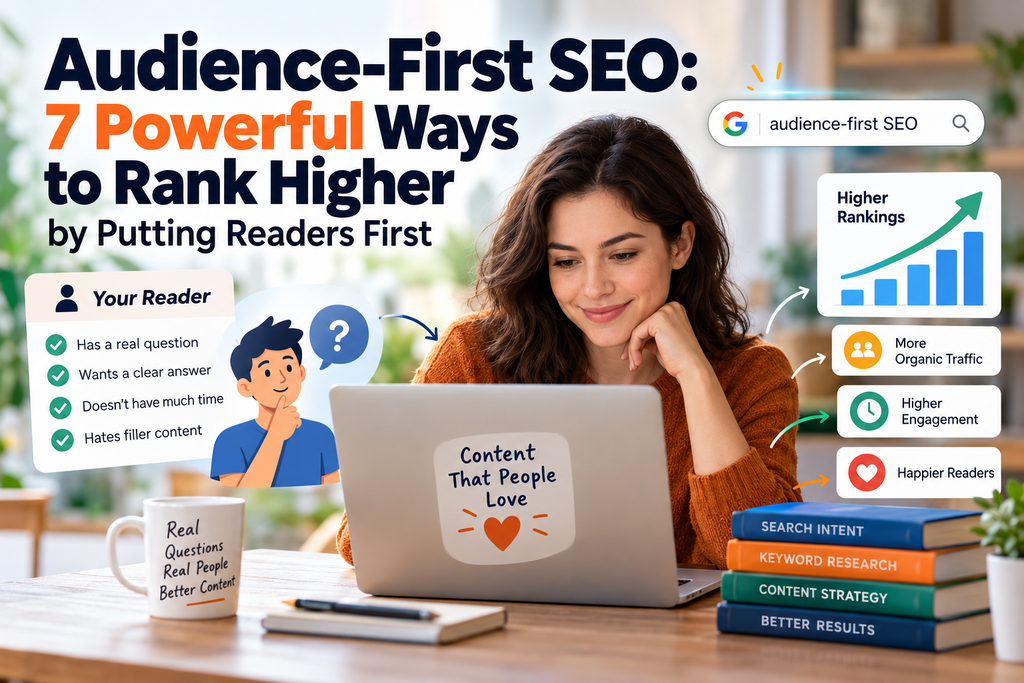
What Is Audience-First SEO?
Audience-first SEO is a content strategy that puts the reader’s needs at the center of the SEO process.
Keywords, search volume, rankings, and competitors still matter. But they don’t determine everything you write.
Instead, you start by understanding:
- Who the reader is
- What problem they’re trying to solve
- Why they’re searching
- What information they need
- What action they want to take next
Then you build the content around those needs.
Think of it this way:
Keyword-first SEO:
“What should I write about this keyword?”
Audience-first SEO:
“What does someone searching this keyword actually want to know?”
The second question usually produces a better article.
Table of Contents
Why Audience-First SEO Matters
Search engines exist to help people find information.
That means creating content that genuinely helps people is a sensible starting point for SEO.
Imagine someone searches for:
“How to write a meta description.”
They probably don’t want a long introduction about the history of search engines.
They want to know:
- What a meta description is
- How to write one
- How long it should be
- What to include
- What to avoid
- Maybe a few examples
An audience-first article gets to those answers quickly.
A keyword-first article might mention “meta descriptions” dozens of times while still making the reader work to find the answer.
That’s the difference.
Good SEO isn’t simply about getting someone onto your page.
It’s about giving them a reason to stay because the page is actually useful.
Audience-First SEO vs. Keyword-First SEO
| Keyword-First SEO | Audience-First SEO |
|---|---|
| Starts with keywords | Starts with the reader’s problem |
| Focuses heavily on search volume | Focuses on search intent |
| May copy competitor structures | Uses competitors to find gaps |
| Keywords influence the outline | Reader questions influence the outline |
| Can prioritize keyword frequency | Prioritizes natural language |
| Often focuses on rankings | Looks at rankings and reader outcomes |
| Can produce generic content | Aims for specific, useful answers |
This doesn’t mean keyword research is no longer important.
It means keywords become a tool rather than the entire strategy.
Start With Search Intent
Before writing an article, figure out what the searcher is actually trying to accomplish.
That’s search intent.
For example, someone searching “best SEO tools” is probably evaluating options.
Someone searching “how to do an SEO audit” probably wants instructions.
Someone searching “what is technical SEO” probably needs an explanation.
Those three searches require different content.
If you misunderstand the intent, even excellent writing can miss the mark.
Informational Intent
The reader wants to learn.
Examples include:
- What is audience-first SEO?
- What is keyword research?
- How does internal linking work?
These searches usually need clear explanations and examples.
Commercial Intent
The reader is researching before making a decision.
Examples:
- Best SEO tools for small businesses
- Ahrefs vs. Semrush
- Best SEO agency for startups
These pages should help readers compare options and understand important differences.
Transactional Intent
The reader is ready to take action.
Examples:
- Buy SEO software
- SEO audit service
- Website optimization package
These pages need clear information about the offering and an obvious next step.
Navigational Intent
The reader wants to reach a particular website or page.
Examples:
- Google Search Console
- WordPress login
- Ahrefs dashboard
Understanding intent helps you decide what type of content to create before you write a single paragraph.
Look at the Search Results
One of the easiest audience-first SEO techniques is to search your target query.
Look at the results.
What types of pages appear?
Are they:
- How-to guides?
- Product pages?
- Comparison articles?
- Videos?
- Lists?
- Forums?
- Official documentation?
The search results provide useful clues about what searchers are looking for.
Suppose you search “content brief template” and most results are downloadable templates.
That tells you something.
A 3,000-word article about the history of content briefs may not satisfy the same intent.
Search results aren’t perfect, but they’re a valuable source of audience research.
Build Your Content Around Questions
Once you understand the search intent, start collecting questions.
For a topic like audience-first SEO, readers might ask:
- What is audience-first SEO?
- How is it different from keyword-first SEO?
- Why does search intent matter?
- Do I still need keyword research?
- How should I structure an audience-first article?
- How do I measure results?
- How long does SEO content take to work?
Those questions can become your content structure.
This is better than creating headings simply because competitors used them.
Instead of:
Benefits
try:
Why does audience-first SEO matter?
Instead of:
Strategy
try:
How do you create an audience-first SEO strategy?
A question-based structure makes the article easier to scan and keeps every section focused on solving a specific problem.
Give Readers the Answer Quickly
One of the biggest mistakes in SEO writing is taking too long to get to the point.
You don’t need five paragraphs of introduction before answering a simple question.
If someone asks how to improve their meta descriptions, start with the practical answer.
Then provide context.
A useful structure is:
Answer → Explanation → Example → Additional detail
This gives readers control.
Someone who wants a quick answer can get it.
Someone who wants to understand the subject more deeply can keep reading.
That’s especially important for mobile readers, who are often scanning rather than reading every word.
Write for Humans, Not Keyword Counters
Keywords are useful.
Keyword stuffing isn’t.
If your focus keyword is audience-first SEO, you don’t need to force the exact phrase into every paragraph.
Use it naturally in places where it makes sense, such as:
- Page title
- H1
- Introduction
- Relevant subheading
- Body content
- Conclusion
- Meta description
Then use related terminology naturally throughout the article.
For example:
- Search intent
- People-first content
- Content strategy
- Keyword research
- Reader experience
- Organic search
- Content quality
- SEO writing
A good article should sound like something a human would actually say.
If inserting a keyword makes a sentence awkward, rewrite the sentence.
The reader shouldn’t be able to tell that you’re trying to satisfy a keyword target.
Don’t Chase Word Count
Longer doesn’t automatically mean better.
If a question can be answered properly in 800 words, there’s no reason to turn it into 3,000 words just because another SEO article recommends a certain length.
Long content can be valuable when the subject requires depth.
But unnecessary length creates friction.
Instead of asking:
“How many words should this article have?”
ask:
“How much information does this reader need to solve the problem?”
That might include:
- Examples
- Step-by-step instructions
- Checklists
- Templates
- Screenshots
- Comparisons
- Common mistakes
- Troubleshooting advice
- Original research
That’s useful depth.
Repeating the same idea five different ways isn’t.
Add Something Competitors Don’t Have
Audience-first SEO isn’t about copying the pages that already rank.
Competitor research should help you understand what exists.
Then look for opportunities to make your article more useful.
Ask:
What’s missing?
Maybe existing articles explain the concept but don’t provide examples.
Maybe they provide examples but don’t explain the process.
Maybe they cover the basics but ignore common mistakes.
Maybe they’re technically accurate but difficult for beginners to understand.
That’s where you can create something better.
Original value might come from:
- Personal experience
- Case studies
- Original data
- Experiments
- Examples
- Templates
- Expert commentary
- Detailed processes
You don’t always need groundbreaking research.
Sometimes explaining something clearly is enough.
Use Your Audience’s Language
One of the most overlooked benefits of audience research is learning how people actually describe their problems.
Businesses often use professional terminology.
Customers don’t always do that.
An SEO professional might talk about “information architecture.”
A customer might say:
“People can’t find anything on my website.”
Both describe a problem.
But the second phrase tells you how the audience thinks about it.
Customer emails, sales calls, support conversations, reviews, forums, and community discussions can reveal this language.
Use it.
When your content reflects the way your audience thinks and asks questions, it becomes easier for them to recognize that the page is relevant.
The Biggest Audience-First SEO Mistake
The biggest mistake is simple:
Writing about what you want to say instead of what the reader needs to know.
It’s easy to fall into this trap.
You know your subject.
You have experience.
You have opinions and examples.
So you start writing everything you know.
But the reader didn’t come to learn everything you know.
They came with a specific problem.
Imagine an article titled:
How to Improve Your Meta Descriptions
If the first section is a detailed history of search engines, you’ve already lost focus.
The reader doesn’t need that.
Give them the solution first.
Then add context if it genuinely helps.
A 5-Step Audience-First SEO Framework
Here’s the process I use when creating or improving SEO content.
1. Identify the Reader’s Intent
Ask:
- What problem brought them here?
- What are they trying to accomplish?
- What do they already know?
- What would a successful answer look like?
Then check the search results to validate your assumptions.
2. Build the Outline Around Their Questions
Use:
- People Also Ask
- Related searches
- Customer questions
- Forums
- Competitor pages
- Search suggestions
- Your own experience
Turn the most useful questions into sections.
3. Write for Clarity
Keep the language simple.
Use short paragraphs.
Give concrete examples.
Avoid unnecessary jargon.
If an idea can be explained in one sentence, don’t use five.
4. Add Keywords Naturally
Use your primary keyword where it fits.
Include related terms where they’re genuinely relevant.
Don’t rewrite perfectly good sentences just to insert an exact-match phrase.
5. Edit From the Reader’s Perspective
This is where many content improvements happen.
Read the article like someone who has never seen your website.
Ask:
- Does the introduction get to the point?
- Is the answer easy to find?
- Do the headings make sense?
- Is anything repeated?
- Is anything unnecessary?
- Are there unanswered questions?
- Is there enough practical detail?
Then cut the filler.
How to Measure Audience-First SEO
Rankings are important, but they’re not the only measurement.
Depending on your goals, look at:
- Organic clicks
- Search impressions
- Rankings
- Click-through rate
- Engagement
- Scroll depth
- Organic conversions
- Leads
- Sales
Time on page can also be useful as a diagnostic metric, but I wouldn’t treat it as proof that Google rewards a page for keeping people around.
A longer session isn’t automatically better.
Someone might spend five minutes because the article is excellent.
They might also spend five minutes because they can’t find the answer.
Context matters.
That’s why audience-first SEO should be measured using several signals rather than one metric.
Update Existing Content Before Creating More
Audience-first SEO isn’t only useful for new articles.
It can be even more useful when updating old content.
Pick an existing article and ask:
What did the reader come here to accomplish?
Then check whether the article actually delivers.
Look at the first 100 words.
Does the introduction clearly explain what the reader will get?
Look at the headings.
Do they answer meaningful questions?
Look for repeated ideas.
Cut them.
Look for unanswered questions.
Add them.
Look for outdated information.
Update it.
Look for places where the explanation is too complicated.
Simplify it.
You may discover that improving one existing page is more valuable than publishing another generic article.
Audience-First SEO for Different Content Types
The approach also changes depending on the type of content you’re creating.
How-To Content
Focus on helping the reader complete a task.
Give them:
- Steps
- Requirements
- Examples
- Common mistakes
- Troubleshooting tips
Comparison Content
Focus on helping the reader make a decision.
Explain:
- Key differences
- Best use cases
- Limitations
- Costs where relevant
- Important features
Beginner Guides
Focus on reducing confusion.
Define unfamiliar terms and don’t assume the reader has expert knowledge.
Product Pages
Focus on helping the reader understand whether the product solves their problem.
Explain what it does, who it’s for, important features, limitations, pricing where appropriate, and what the next step is.
FAQ Pages
Answer the question directly.
Not every FAQ needs a 1,500-word response.
Sometimes the most useful answer is three clear sentences.
What Audience-First SEO Cannot Fix
It’s important not to treat content as a magic solution.
Audience-first SEO won’t automatically fix:
- A technically broken website
- Poor page speed
- Indexing problems
- Weak internal linking
- A lack of authority
- Extremely competitive topics
- Very low search demand
- Poor conversion paths
It makes your content more useful.
It doesn’t replace technical SEO, link building, website performance, conversion optimization, or broader marketing.
SEO is still a system.
Audience-first SEO simply makes the content component more focused on the people you’re trying to reach.
An Audience-First SEO Checklist
Before publishing, ask:
- Can I describe the reader’s main question in one sentence?
- Does the introduction answer that question or clearly promise an answer?
- Does the content match search intent?
- Does every H2 have a clear purpose?
- Can readers find the important information quickly?
- Have I included practical examples?
- Is anything there simply to increase word count?
- Are keywords used naturally?
- Have I removed repetition?
- Have I explained technical terms?
- Have I addressed common questions?
- Have I included relevant limitations?
- Does the article provide something genuinely useful?
- Is there a clear next step for the reader?
If the answer to several of these questions is no, the article probably needs another edit.
Final Thoughts: Start With the Reader
Audience-first SEO is easy to understand but harder to practice.
The temptation to start with keywords is strong because keywords are measurable.
Search volume is a number.
Keyword difficulty is a number.
Rankings are numbers.
Readers are more complicated.
They have questions, frustrations, expectations, different levels of knowledge, and limited attention.
That’s why the best starting point isn’t:
“What keyword should I rank for?”
It’s:
“Who am I trying to help, and what do they need from this page?”
Once you understand that, keyword research becomes more useful.
Your outline becomes clearer.
Your writing becomes more focused.
Your editing becomes easier.
And your SEO strategy starts working toward something more meaningful than a ranking alone: creating content that people actually find useful.
So, the next time you publish an SEO article, don’t begin with keyword density.
Begin with the reader.
Find the question.
Understand the intent.
Answer it clearly.
Then optimize the page around that useful answer.
That’s the foundation of audience-first SEO.
Looking for the best SEO expert in Kochi to improve your website’s visibility and attract more potential customers? A professional SEO expert can help your business achieve higher search engine rankings through effective keyword research, on-page optimization, technical SEO, quality content, and strategic link building. Whether you run a local business, e-commerce store, or service-based company, working with an experienced SEO expert in Kochi can help increase organic traffic, improve online visibility, and generate more qualified leads. Choose the right SEO professional who understands your business goals and delivers a customized strategy for sustainable search engine growth.