
Search used to be simple. Someone typed a question, Google showed ten blue links, and your job was to land on page one.
That model is fading. Google now answers many questions directly through AI Overviews and AI Mode. For AI search for brands, the goal is no longer just to rank. The goal is to become the source the AI trusts and references.
Here’s what is changing, what I’ve seen work, and what you can do this month.
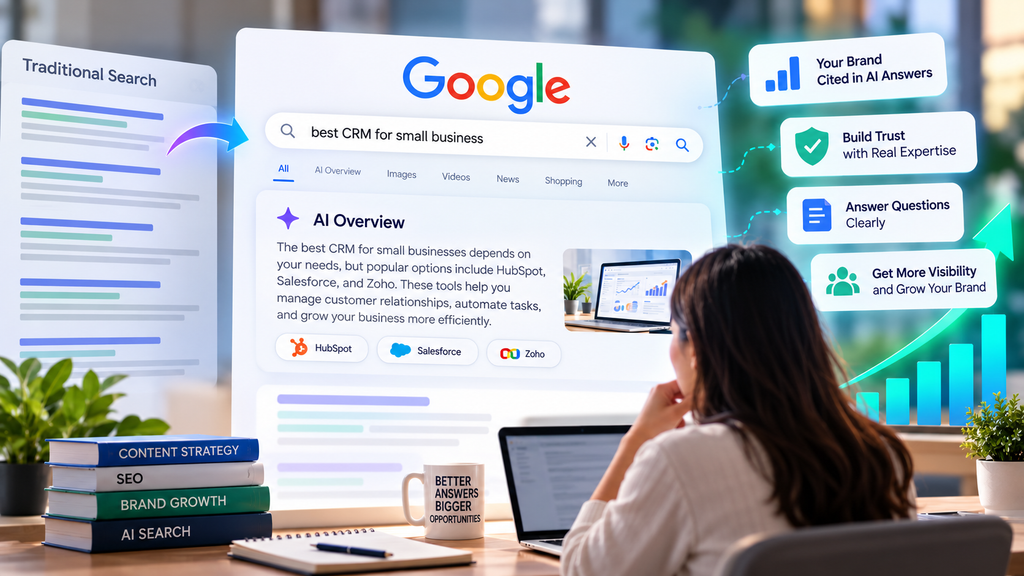
What Is Changing in Google Search?
Google is turning from a list of links into an answer engine. Three changes matter most.
AI Overviews
AI Overviews are summaries that appear at the top of some results. They pull information from multiple pages and show links to the sources. If your content isn’t clear and trustworthy, it won’t get pulled in.
AI Mode
AI Mode lets people ask longer, more conversational questions and follow up with more. It behaves less like a search box and more like a chat. Your brand now competes to be part of the answer, not only to be one of the results.
More Zero-Click Searches
Many people get what they need without clicking anything. That doesn’t mean traffic is dead. It means the clicks you do get are more valuable, and your brand mentions carry more weight.
Table of Contents
Why AI Search for Brands Is About Being the Source
The biggest shift is simple. People increasingly get answers straight from AI or from Google’s summaries. So being the source of a useful, trustworthy answer now matters more than ranking for a single keyword.
AI systems need content they can understand and confidently reference. That means clear answers, real expertise, and accurate information.
The good news is that the basics still apply. Google’s own guidance on AI features says the same SEO fundamentals support visibility in AI experiences. Your content still needs to be crawlable, indexable, and genuinely helpful.
Traditional SEO vs. AI Search: What Changes?
| Factor | Traditional SEO | AI search |
| Main goal | Rank on page one | Be cited or referenced in the answer |
| Content focus | Keywords and volume | Questions, clarity, expertise |
| Success metric | Rankings and clicks | Citations, brand mentions, clicks, conversions |
| Winning format | Long, keyword-rich pages | Direct answers with supporting depth |
| Trust signals | Backlinks | Backlinks plus first-hand expertise and accuracy |
A Real Example: Rewriting Around Reader Questions
We had a how-to article that relied heavily on traditional SEO. It targeted the right keywords, but it buried the answers.
So we rewrote it around the questions readers actually ask. We put a clear, concise answer near the top of each section and kept the deeper explanation below it.
After the rewrite, the article started getting more visibility in AI-generated search summaries. Organic traffic stayed strong at the same time. We didn’t have to choose between traditional SEO and AI visibility.
[Add a specific result here, such as a change in impressions or the number of AI citations you noticed.]
The Biggest Mistake Brands Make
The most common mistake is creating content for algorithms instead of people.
Brands often focus on keywords and publishing volume. Meanwhile, they overlook the things that make content worth surfacing: clear answers, first-hand expertise, and genuinely useful information.
Here’s how that looks in practice:
- Pages stuffed with keywords but light on real answers
- Generic advice that any competitor could publish
- No original examples, data, or experience
- Claims with no sources behind them
AI systems can find generic content everywhere. They have little reason to cite yours.
How to Optimize for AI Search: A 6-Step Process
This is the process I follow. It works for both readers and search engines.
- Understand search intent. Find the questions your audience actually asks. Use customer emails, sales calls, and “People also ask” boxes.
- Answer clearly and directly. Put the key information near the top of the page.
- Add real expertise. Include original insights, examples, or data that only you can offer.
- Structure for easy understanding. Use clear headings, concise sections, and FAQs.
- Strengthen trust signals. Cite credible sources and keep your information accurate. Google’s people-first content guidance is a good checklist.
- Review for humans first. Ask yourself whether the page is genuinely useful, not just optimized.
That last step matters most. If a page only works for AI, it won’t work for long.
How to Track Your Visibility in AI Search
You can’t manage what you don’t measure, but tracking is still messy. No single dashboard shows everything. I use a mix of three signals:
- AI citations: I regularly test our most important queries across AI search tools and check whether our content is referenced.
- Brand mentions: I watch whether our name appears in answers, even without a link.
- Organic performance: I compare all of this with changes in impressions, clicks, and conversions in Google Search Console.
Keep a simple spreadsheet with your top 10 to 20 queries. Test them monthly and note what changes. The trend matters more than any single result.
The One Change to Make This Month
You don’t need a full strategy overhaul. Start with one move.
Make your existing content more directly useful. Identify the questions your customers ask most. Then rewrite your key pages to answer them clearly, accurately, and with real expertise.
Start with your top five pages by traffic or revenue. For each one, ask:
- Does the page answer the main question in the first few lines?
- Would a customer find something here they couldn’t get elsewhere?
- Is every claim accurate and backed by a source?
Limitations to Keep in Mind
Be honest about what nobody knows yet. AI search features change often, and no one can guarantee a citation. Results also vary by industry, query type, and how established your brand is.
Treat this as steady, evidence-based improvement, not a trick. Test, measure, and adjust.
FAQs About AI Search for Brands
Is SEO dead because of AI search?
No. The fundamentals still matter, including quality content, technical health, and trust. What changes is the goal. You now aim to be referenced, not only ranked.
What is generative engine optimization (GEO)?
GEO means shaping your content so AI systems can understand, trust, and cite it. In practice, it overlaps heavily with good SEO and people-first content.
How do I know if AI search cites my brand?
Test your key queries in AI search tools, log the results monthly, and compare them with your Search Console data.
Do I need to publish more content?
Usually not. Improving your existing key pages often beats publishing more thin ones. With AI Search for Brands, the focus should be on creating content that provides clear, useful answers and demonstrates genuine expertise. Before publishing another article, review your existing pages and identify opportunities to add original insights, helpful examples, accurate information, and direct answers to customer questions.
A smaller collection of high-quality, trustworthy pages can give your brand more opportunities to appear in AI-generated answers than a large library of repetitive content. Focus on making every important page genuinely useful to both your audience and search engines.
Usually not. Improving your existing key pages often beats publishing more thin ones.
A strong AI Search for Brands strategy starts with your most important pages. These might include product pages, service pages, guides, comparison articles, FAQs, and educational resources. Make sure each page gives readers a clear answer without forcing them to search through unnecessary text.
Publishing dozens of similar articles can also make it harder to maintain quality. Instead, focus on building a smaller library of authoritative content that demonstrates your expertise. This gives AI systems more useful information to understand your brand and potentially reference when answering relevant questions.
Another important part of AI Search for Brands is updating existing content. Review older pages regularly and remove outdated information, replace weak examples, verify statistics, and add new insights. Fresh and accurate information can make your content more useful to both people and search engines.
How AI Search for Brands Changes Content Strategy
AI Search for Brands changes the way businesses should think about content. Instead of creating separate pages for every small keyword variation, focus on broader topics and the questions your audience genuinely wants answered.
Start by identifying the problems your customers are trying to solve. Then create content that answers those questions from multiple angles. Include definitions, examples, comparisons, practical steps, and supporting evidence where appropriate.
This approach helps your content become more useful to readers while giving AI systems clearer information to understand and reference. Your brand should be presented as a helpful source, not simply as a website trying to rank for keywords.
How to Make Your Brand More Visible in AI Search
Improving visibility in AI Search for Brands starts with making your expertise easy to understand. Your website should clearly explain what your company does, who it serves, and what makes its experience relevant.
Use descriptive headings and answer important questions directly. Support important claims with reliable sources and include original information whenever possible. Case studies, expert commentary, research, product experience, and first-hand examples can make your content more distinctive.
It is also important to maintain consistency across your website. Your company name, products, services, authors, and key facts should be presented accurately and consistently. Clear information makes it easier for search systems to understand the relationship between your brand and the topics you cover.
What Makes Content Valuable for AI Search?
The foundation of AI Search for Brands is useful content. AI systems have access to huge amounts of information, so simply repeating information that already exists is unlikely to make your content distinctive.
Ask whether your page adds something new. Can you provide original research, practical experience, unique examples, expert analysis, or a clearer explanation than competing pages?
Content should also be easy to scan. Use concise paragraphs, descriptive headings, bullet points, tables, and direct answers where they improve readability. Make the most important information easy for both readers and search systems to identify.
Build a Long-Term AI Search Strategy
AI Search for Brands should be treated as an ongoing content and SEO process rather than a one-time optimization project. Search features, user behavior, and AI-generated answers continue to evolve.
Review your most important pages regularly. Track which topics generate traffic, conversions, brand mentions, and AI citations. When you identify gaps, improve the existing content before automatically creating another page.
Over time, this creates a stronger content library built around your customers’ questions and your brand’s expertise. The objective is simple: create information that people find useful and that AI systems can underst
How Brand Authority Supports AI Search
Strong brand authority can play an important role in AI Search for Brands. When your website consistently publishes accurate and useful information, it becomes easier for search systems to understand what your brand knows and what topics it covers.
Show your expertise through detailed author information, original research, customer examples, case studies, and practical recommendations. If your team has first-hand experience with a topic, explain that experience clearly rather than relying only on generic information available elsewhere.
You should also keep your business information consistent across important online profiles and platforms. Accurate company details help establish a clearer connection between your brand and the subjects you discuss.
Create Content Around Real Customer Questions
One effective way to improve AI Search for Brands visibility is to build content around the questions customers ask before making a decision.
Review questions from sales calls, customer support conversations, product demos, reviews, and website searches. These questions can reveal useful topics that keyword research alone may miss.
For example, instead of creating a page around a broad keyword, build a resource that answers related questions such as:
- What problem does the product solve?
- How does it compare with alternatives?
- Who is it best suited for?
- What does it cost?
- What are the common limitations?
- How should someone get started?
This creates content that is useful throughout the customer journey and gives AI systems more context about your brand.
Use Original Data to Stand Out
Original data can make your content more distinctive in AI Search for Brands. Industry statistics are useful, but information produced from your own customers, research, surveys, experiments, or business experience can provide additional value.
Consider publishing anonymized customer trends, survey findings, benchmark reports, original research, or insights from your own projects. Explain how the data was collected and what it means.
Even small datasets can become valuable content when they answer a specific question that your audience cares about.
Improve Existing Content Before Creating New Pages
A common mistake in AI Search for Brands is assuming that more pages automatically create more visibility. In many cases, existing content has greater potential.
Review pages that already receive impressions but have low clicks or engagement. Look for sections that are outdated, unclear, repetitive, or missing important customer questions.
You can improve these pages by:
- Adding direct answers near the beginning
- Updating outdated statistics and examples
- Adding original insights
- Improving headings and structure
- Supporting claims with credible sources
- Removing unnecessary information
- Adding relevant FAQs
- Strengthening internal links
This approach can improve the usefulness of your existing content without requiring a constant publishing schedule.
Connect Your Content Across Related Topics
A strong AI Search for Brands strategy should not rely on isolated articles. Build groups of related content around important topics.
For example, a brand that sells CRM software could create a central guide about CRM systems and connect it to supporting pages about CRM features, implementation, pricing, integrations, comparisons, and common questions.
Internal links help readers move between related resources while giving search engines additional context about how your content is connected.
Don’t Ignore Traditional SEO
While AI Search for Brands introduces new opportunities, traditional SEO remains important. AI search systems still need to discover and understand your website before they can potentially use its information.
Maintain strong technical foundations, including crawlability, indexability, page performance, descriptive titles, useful headings, internal links, and structured content.
The practical approach is not to choose between SEO and AI search. Build content that satisfies users first while maintaining the technical fundamentals that allow search systems to access and understand it.
Measure More Than Rankings
Traditional rankings alone do not tell the full story of AI Search for Brands. Your measurement approach should also consider how your brand appears in AI-generated answers.
Create a list of important questions related to your products, services, and industry. Test those queries periodically and record whether your brand is mentioned, whether your content is referenced, and which competitors appear.
Combine those observations with traditional metrics such as impressions, clicks, conversions, and branded searches. Looking at multiple signals gives you a broader view of how your visibility is changing.
Focus on Trust, Not Tricks
There is no guaranteed formula for making an AI system cite a particular page. That makes shortcuts and artificial optimization risky.
The strongest approach to AI Search for Brands is to create content that genuinely deserves to be referenced. Answer questions accurately, disclose relevant limitations, provide evidence for important claims, and demonstrate first-hand knowledge.
As AI search continues to evolve, useful and trustworthy content gives your brand a foundation that can adapt to new search experiences.
What Does AI Search for Brands Mean?
AI Search for Brands refers to the growing importance of making your brand visible in AI-powered search experiences. Instead of simply showing a list of webpages, AI search can provide direct answers and use information from multiple sources to build those answers.
For brands, this creates a new opportunity. Your website is no longer competing only for a position in traditional search results. Your content can also become a source that AI systems understand, reference, and associate with a particular topic.
A successful AI Search for Brands strategy therefore focuses on useful information, clear answers, strong expertise, and trustworthy sources.
Why AI Search for Brands Matters
The importance of AI Search for Brands comes from the way people are changing how they find information. Users can now ask detailed questions and receive summarized answers without visiting several websites.
This means brands need to think beyond traditional rankings. A page can attract attention even when a user does not immediately click through to the website. Being mentioned or referenced in an AI-generated answer can help users discover and recognize a brand.
For this reason, AI Search for Brands should become part of a broader search strategy rather than replacing traditional SEO.
How to Optimize Content for AI Search for Brands
Optimizing for AI Search for Brands starts with creating content that directly answers the questions your audience is asking.
Use clear headings, concise explanations, relevant examples, and supporting evidence. Avoid hiding the main answer beneath unnecessary introductions. Make it easy for readers to understand the key point quickly.
You should also demonstrate first-hand expertise. Include original research, case studies, customer insights, examples, expert commentary, or data that adds something beyond information already available online.
The goal of AI Search for Brands is not to repeat a keyword as many times as possible. It is to create content that provides enough useful context for search systems to understand your expertise and your brand’s relevance.
AI Search for Brands vs. Traditional SEO
Traditional SEO focuses heavily on helping webpages rank for specific searches. AI Search for Brands expands that objective by considering how your information can be understood and used within AI-generated answers.
This does not mean traditional SEO is no longer important. Technical SEO, quality content, crawlability, indexing, internal linking, and authority still provide the foundation.
The difference is that AI Search for Brands puts greater emphasis on answering questions clearly and establishing your website as a reliable source of information.
How to Measure AI Search for Brands Visibility
Measuring AI Search for Brands requires more than checking keyword rankings. Create a list of important questions that potential customers might ask about your products, services, and industry.
Test these questions across relevant AI search experiences and record:
- Whether your brand is mentioned
- Whether your website is referenced
- Which pages are cited
- Which competitors appear
- What information is associated with your brand
You can then compare these observations with traditional SEO metrics such as impressions, clicks, branded searches, and conversions.
Over time, this gives you a clearer picture of how your AI Search for Brands visibility is developing.
Build a Sustainable AI Search for Brands Strategy
A sustainable AI Search for Brands strategy does not depend on publishing hundreds of new articles. Start with the content that already matters most to your business.
Review your top pages, identify unanswered customer questions, improve weak sections, add original expertise, and keep important information updated.
Then measure the results and continue improving the pages that have the greatest potential. This approach helps your brand build a useful content library that can support both traditional search and emerging AI search experiences.
Conclusion: Start With Your Best Pages
AI search for brands isn’t a threat if you focus on what has always worked: helping people. Answer real questions clearly. Show real expertise. Back up your claims.
This week, pick your top five pages and rewrite them around your customers’ most common questions. Then track what happens.
Looking for the best SEO expert in Kochi to improve your website’s visibility and attract more potential customers? A professional SEO expert can help your business achieve higher search engine rankings through effective keyword research, on-page optimization, technical SEO, quality content, and strategic link building. Whether you run a local business, e-commerce store, or service-based company, working with an experienced SEO expert in Kochi can help increase organic traffic, improve online visibility, and generate more qualified leads. Choose the right SEO professional who understands your business goals and delivers a customized strategy for sustainable search engine growth.